
Case Study
Ecommerce SEO & Conversion Optimization for Lost & Found
A twelve-year SEO and growth partnership with one of Toronto’s premier menswear retailers now driving the majority of its revenue through organic search.
Services: Shopify SEO · Conversion Rate Optimization · Email Optimization · Growth Advisory
The results, across a twelve-year partnership
All figures in Canadian dollars. Windows noted per metric.
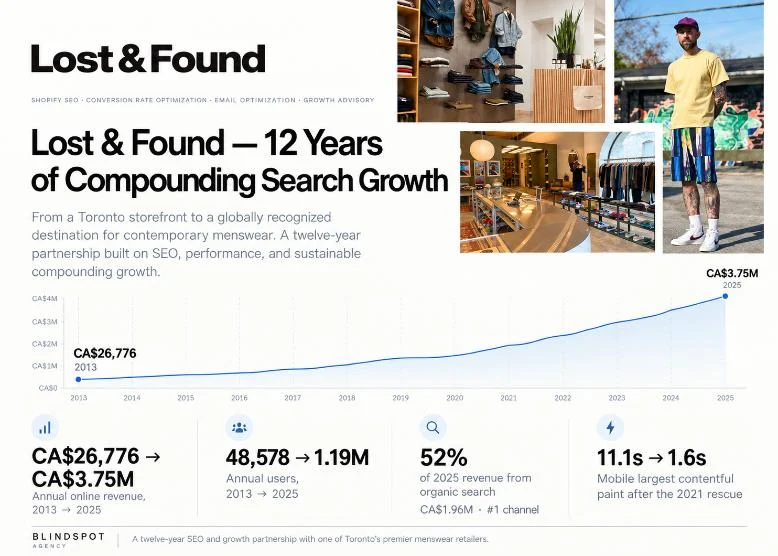
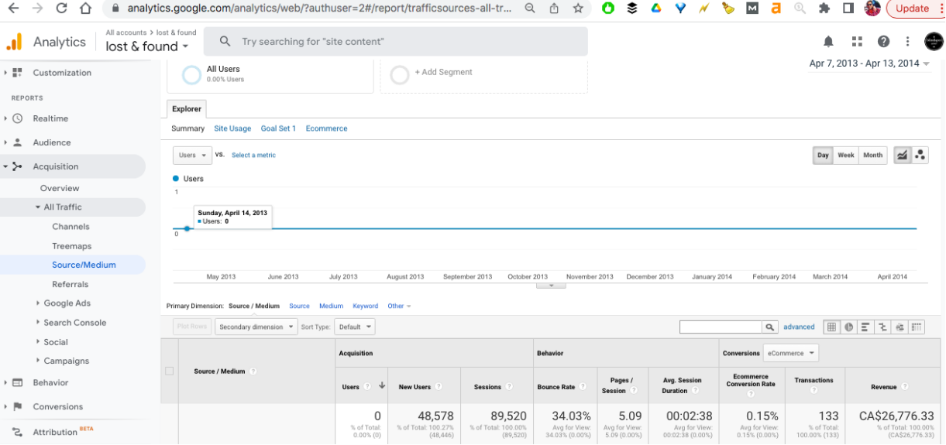
CA$26,776 → CA$3.75 Million
Annual online revenue (2013 → 2025)
48,578 → 1.19 Million
Annual users (2013 → 2025)
52% of revenue from organic search
CA$1.96M, the #1 channel (2025)
Overview
- Industry: Multi-brand menswear retail & ecommerce
- Services: Shopify SEO (technical, on-page, off-page) · CRO · Email optimization · Growth strategy
- Location: Toronto, Ontario, Canada
Blindspot Agency has provided Shopify SEO, conversion rate optimization, and growth advisory to Lost & Found (shoplostfound.com), a premium menswear retailer in Toronto, since 2013. Known for a tightly curated selection of cult American, Japanese, and Scandinavian labels — The Real McCoy’s, Alden, Engineered Garments, and BEAMS PLUS among them — Lost & Found serves a global audience from its Toronto flagship. Over the relationship, it grew from CA$26,776 in annual online revenue to CA$3.75 million, and organic search became its single largest channel — responsible for 52% of all revenue in 2025.
The challenge: a respected retailer that search couldn’t find
n 2013, Jonathan Elias, co-founder of Lost & Found, reached out after hitting a plateau in retail sales and watching competitors outrank the store for the same products online. Lost & Found had the reputation — later named “Canada’s coolest and friendliest menswear store” by GQ — but almost none of the search visibility that reputation deserved. The brand was effectively invisible to the customers searching for exactly what it sold. And it wasn’t converting enough of the ones that were landing on the site.
At the time, Lost & Found had no SEO foundation in place. The opportunity was not a single fix; it was building search as a growth channel from the ground up and doing it in a way that translated the store’s real advantage, its curation and point of view, into search visibility rather than chasing volume for its own sake.
Act one — building the SEO foundation (2013)
Blindspot started with the fundamentals that most retailers skip. Working directly with Jonathan, the team rebuilt the on-page basics — page titles and meta descriptions, header structure on key pages, and a redesigned homepage — and introduced the off-page and email practices that compound over time: cleaning and segmenting the subscriber list, redesigning email templates and subject lines, and establishing the habits that would let search traffic grow.
The foundation paid off quickly:
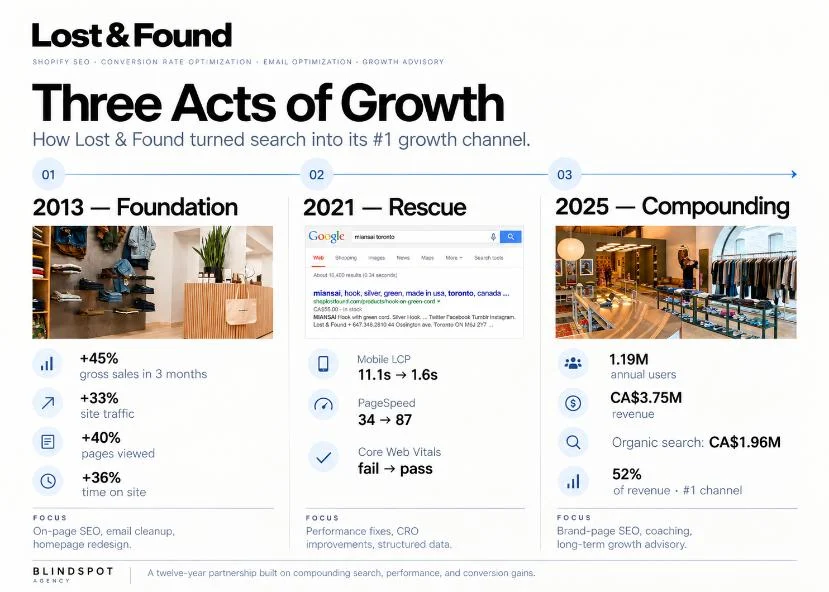
- +45% gross sales within three months of implementation
- +33% site traffic, +40% pages viewed, +36% time on site
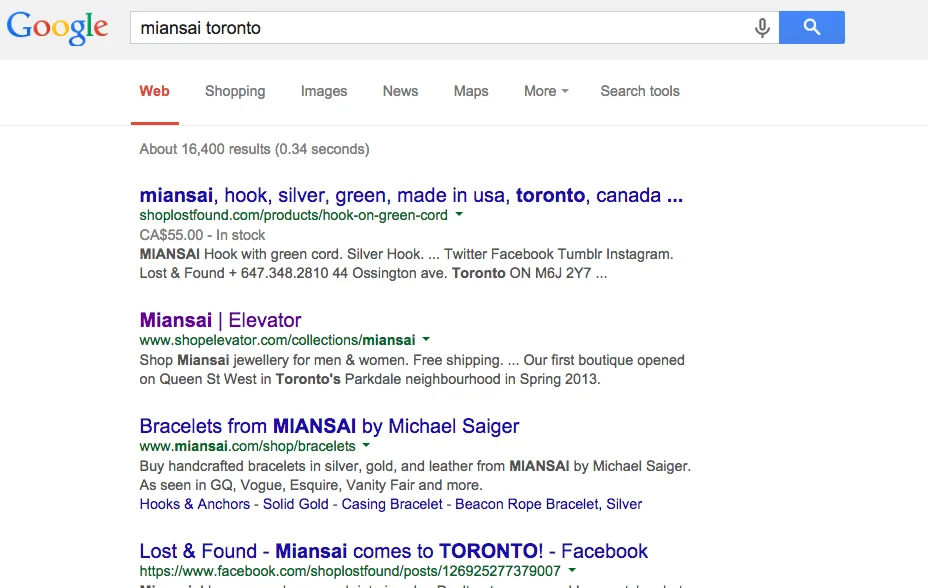
- #1 rankings for several key brands like Miansai
- Within a year, earned media from Complex, BlogTo, Toronto Life, and Post City
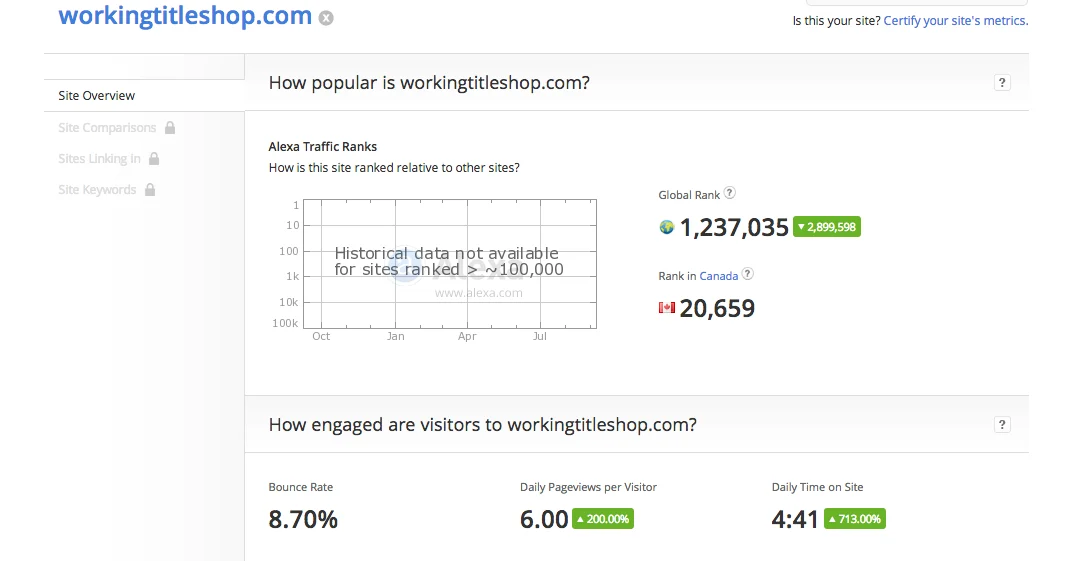
The same playbook, applied to Lost & Found’s then sister store Working Title, produced a 200% increase in pageviews and a 700% increase in time on site.
Act two — the 2021 rescue: fixing performance after a slow rebuild
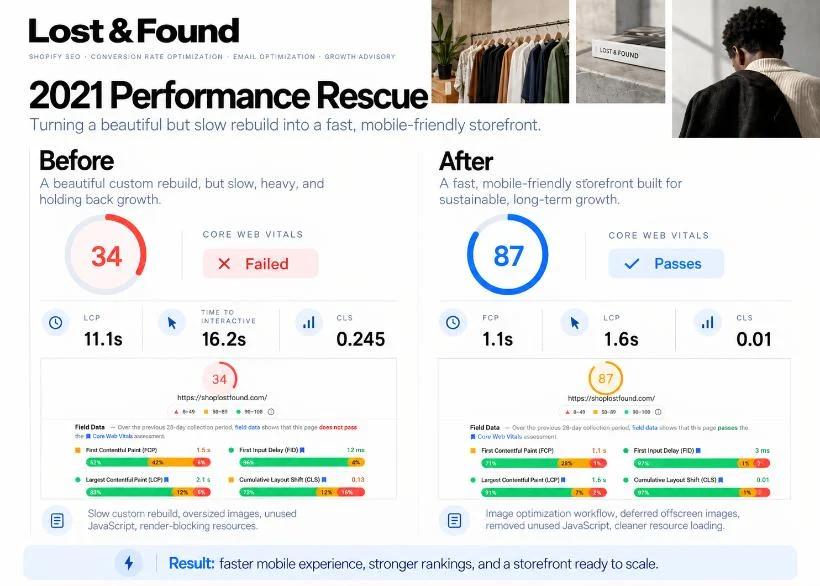
By 2021, Lost & Found had grown enormously and commissioned a custom design-and-build from a New York studio. The new site looked the part but loaded slowly — especially on mobile, where most of the traffic now lived. Google’s Core Web Vitals had just become a ranking factor, and the new theme was failing it: a mobile score of 41/100 at audit, with largest-contentful-paint load times above 11 seconds.
This was the moment Scott Johnston — who had grown from a retail role into Lost & Found’s digital lead — came into the work. Blindspot coached Scott directly while executing the technical rescue alongside the team:
- A repeatable image-optimization workflow so the photography team could compress and correctly label every product image before upload — the single biggest drag on mobile speed
- Deferring offscreen images, removing unused JavaScript, and eliminating render-blocking resources
- Rewritten titles and meta descriptions benchmarked against competitors, improved header structure, and product-page filters
- Structured data (product and review schema) to earn richer search results
As the catalog scaled past 90 brands and 25 categories, conversion came to depend as much on product discovery as on speed. Blindspot’s CRO work focused the shopping journey where fashion retail actually converts — New Arrivals into key collections into high-intent product pages — with filtering and navigation rebuilt so a deep catalog stayed easy to shop. Alongside it, email was tightened with competitor-benchmarked subject lines to lift opens and click-through.
The performance turnaround was dramatic: mobile largest-contentful-paint fell from 11.1s to 1.6s, PageSpeed rose from 34 to 87, and the site moved from failing Core Web Vitals to passing. Mobile traffic climbed with it. Across the 2021–22 window, Lost & Found reached 389,753 annual users and CA$1.85M in revenue, with its conversion rate nearly six times its 2013 level.
Act three — compounding: organic search becomes the #1 channel (2025)
The strategy kept paying forward. Rather than depend on Blindspot full-time, Lost & Found invested in building the capability in-house — Scott trained up with Blindspot’s coaching and a BrainStation course the company funded — with Blindspot staying on as ongoing advisor. Alongside the technical work, the focus turned to growing Lost & Found’s highest-value brands through dedicated category and brand-page SEO.
By 2025, the results of a decade of compounding were clear:
- 1.19M annual users and CA$3.75M in revenue
- Organic search is now the #1 channel, driving CA$1.96M — 52% of all revenue — ahead of direct, email, and paid
- The growth in Lost & Found’s priority brands tracked directly with the search strategy built around them
- A genuinely global audience: Canada and the United States lead, with meaningful demand across Japan, South Korea, and the United Kingdom
On the back of this growth, Lost & Found has since outgrown its original shop, moving into a larger Toronto flagship — the physical counterpart to what the online channel had become.
Why this approach worked
Search is the rare marketing channel that compounds. The foundation laid in 2013 kept returning value a decade later, because every title rewritten, every image optimized, and every brand page built added to an asset that keeps working without ongoing spend. By pairing technical rigor — the kind that turned an 11-second mobile load into 1.6 — with a patient, compounding content and brand strategy, Blindspot helped Lost & Found turn organic search from an afterthought into the engine behind the majority of its revenue.
Just as important: Blindspot built the capability into the client’s own team rather than creating dependency. That is why the relationship has lasted twelve years and counting.
What Lost & Found says
Emmanuel has been amazing. He’s provided some much-needed direction for our business, helping us to be streamlined so we can focus on things that really matter and reduce our time wasted. He’s super knowledgeable, and very happy to take the time to explain things in depth. I highly, highly recommend.
Scott Johnston – Retail and Website Lead, Lost and Found
