A quick overview of the topics covered in this article.
As AI continues to revolutionize every industry it touches, the legal AI race is heating up as lawyers and law firms prepare for a future where an “AI lawyer” doing end-to-end legal work feels increasingly realistic. The legaltech industry has seen major investment activity over the last few years, with its own run of unicorns like Checkr, Relativity, and Ironclad. And while hundreds of large and small legaltech firms have launched recently, Harvey—with its Suits-inspired naming—seems poised to hit the mainstream as the platform of choice for top law firms.
Founder Winston Weinberg told Bloomberg in 2025, “the $1 trillion legal market is too big for any one player to dominate.” That sounds modest for a company that confirmed it raised $160M at an ~$8B valuation—and is now reportedly in talks to raise another ~$200M at an ~$11B valuation, led by Sequoia and Singapore’s GIC, just months after the $8B round.
Weinberg has also framed the total addressable market (TAM) as roughly $1T, with only ~$30B currently spent on technology, implying a massive “still-early” runway. And the revenue trajectory is compounding fast: Harvey reportedly crossed ~$100M ARR in August 2025 and reached ~$190M ARR by the end of 2025, nearly doubling in less than six months.
Here’s why we think he’s being too modest
1) The financial backing: a16z (and now the Sequoia/GIC signal)
a16z’s investment helped frame Harvey as a category-defining company rather than “just another legaltech tool.” Their public focus on IPO readiness—and their history backing companies that become default platforms—helps explain why the market is willing to price in outsized outcomes.
What’s changed recently is that the funding conversation appears to be escalating: Harvey’s reported move from ~$8B to ~ $11B in a matter of months (if the current talks close) reinforces that VCs are treating legal AI less like a feature layer and more like a foundational enterprise category.
Harvey AI (reported milestones)
- Crossed ~$100M ARR (Aug 2025)
- Reached ~$190M ARR (end of 2025)
- Valuation progression (reported):
- Series D (Feb 2025): ~$3B
- Series E (Jun 2025): ~$5B
- Oct 2025 round: ~$8B
- Feb 2026 talks: ~$11B

On paper, those moves imply investors are pricing in much larger future revenue, rapid expansion, and category-defining position.
One hypothesis is that Harvey could eventually become an acquisition target for a major AI platform partner, given how strategically “embedded” it is in legal workflows. The opposite could also be true: model providers may choose to build more vertical products in-house. Either way, what’s clear is that distribution and workflow ownership—not just model quality—are driving valuation narratives.
2) Massive organic reach: why investors are probably excited
Key stats (U.S.-only, as reported):
- 10,789 monthly organic clicks
- $108K+ monthly “SEO value” (estimated replacement cost via paid clicks)
- 20,915 ranking keywords
- 1.74M monthly U.S. query reach
- ~90% of traffic driven by branded demand
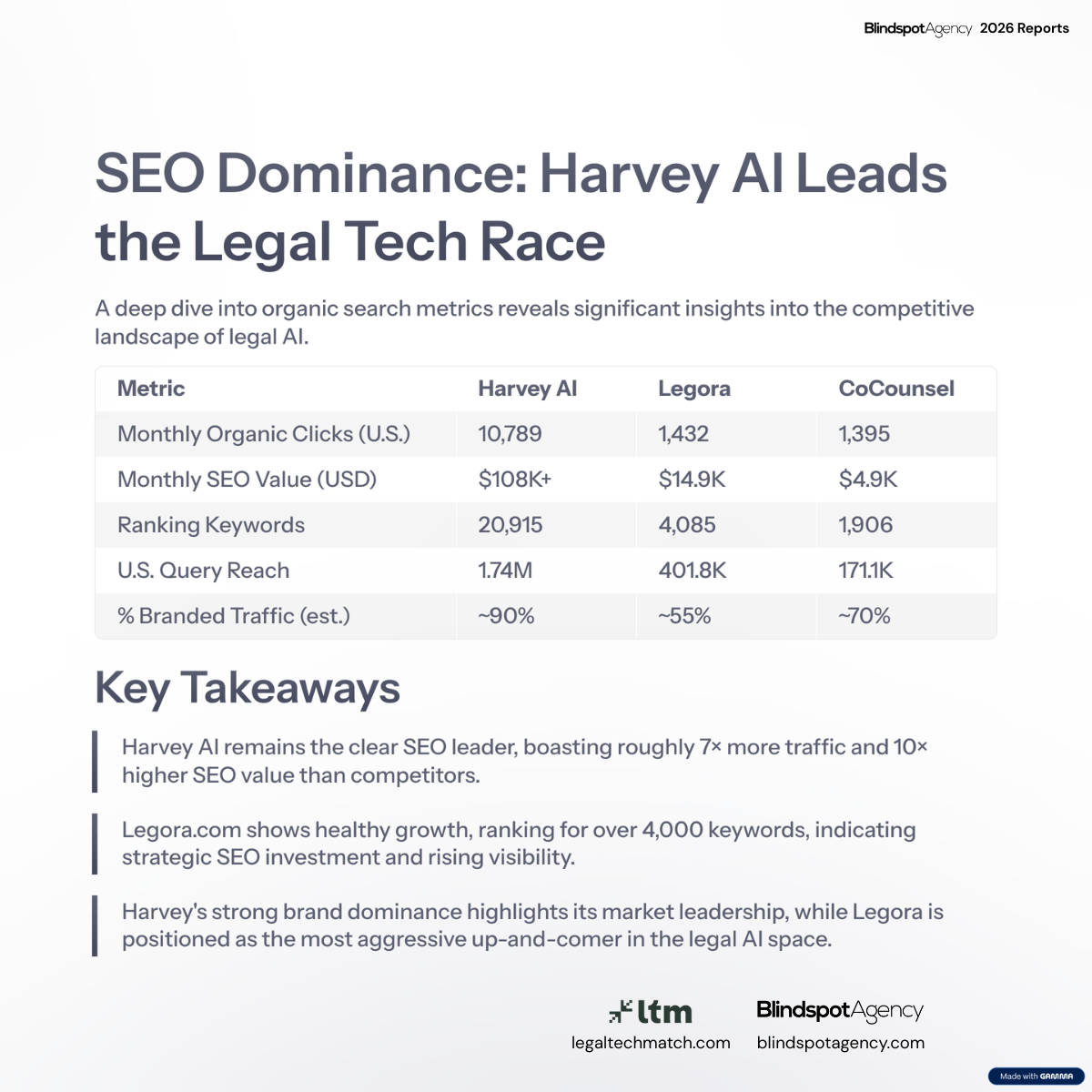
Harvey appears far ahead of many competitors in U.S. organic visibility, which translates into awareness, demand capture, and lead flow.
Two standout areas where this shows up:
Branded search
~22,000 U.S. searches/month for “Harvey AI” indicates deep-funnel brand recognition—this is not generic demand like “best legal AI,” it’s buyers searching for Harvey specifically.
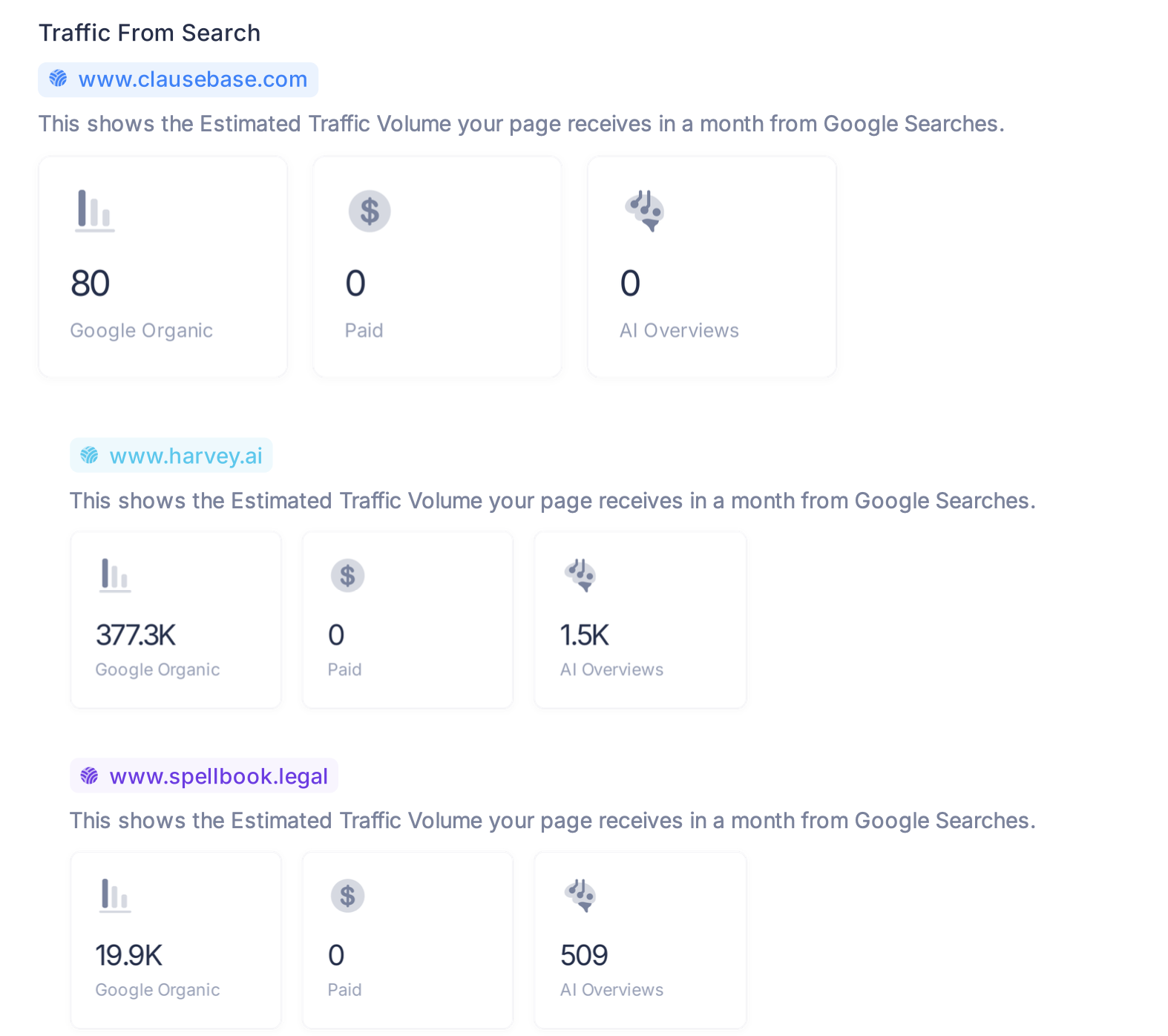
AI Overviews / GEO / AEO
While these metrics fluctuate, what’s consistent is Harvey’s outperformance in answer engines and generative discovery—signals that matter because legal buyers increasingly discover vendors through AI summaries and recommendation-style result
3. What “number two” looks like: Legora (and why the gap is shrinking fast)
Harvey may be the valuation leader, but Legora—the Swedish collaborative AI platform for legal workflows—is scaling quickly. Legora announced its $150M Series C at a ~$1.8B valuation in October 2025 to accelerate global expansion, with backing that included Y Combinator.
Now, Legora is reportedly in talks for a new funding round that could value it at ~$4B, more than double that October valuation.
Operationally, the scale story is becoming real:
- Offices in Stockholm, London, New York, and Sydney
- Growth from ~250 firms (May 2025) to 400+ firms across 40 markets
- Reported ~$23M ARR, described as a sixfold increase
- YC-linked framing that Legora has become one of YC’s fastest unicorns
Two big raises. Both unicorns. Both expanding globally. It’s tempting to read this as a two-horse race.
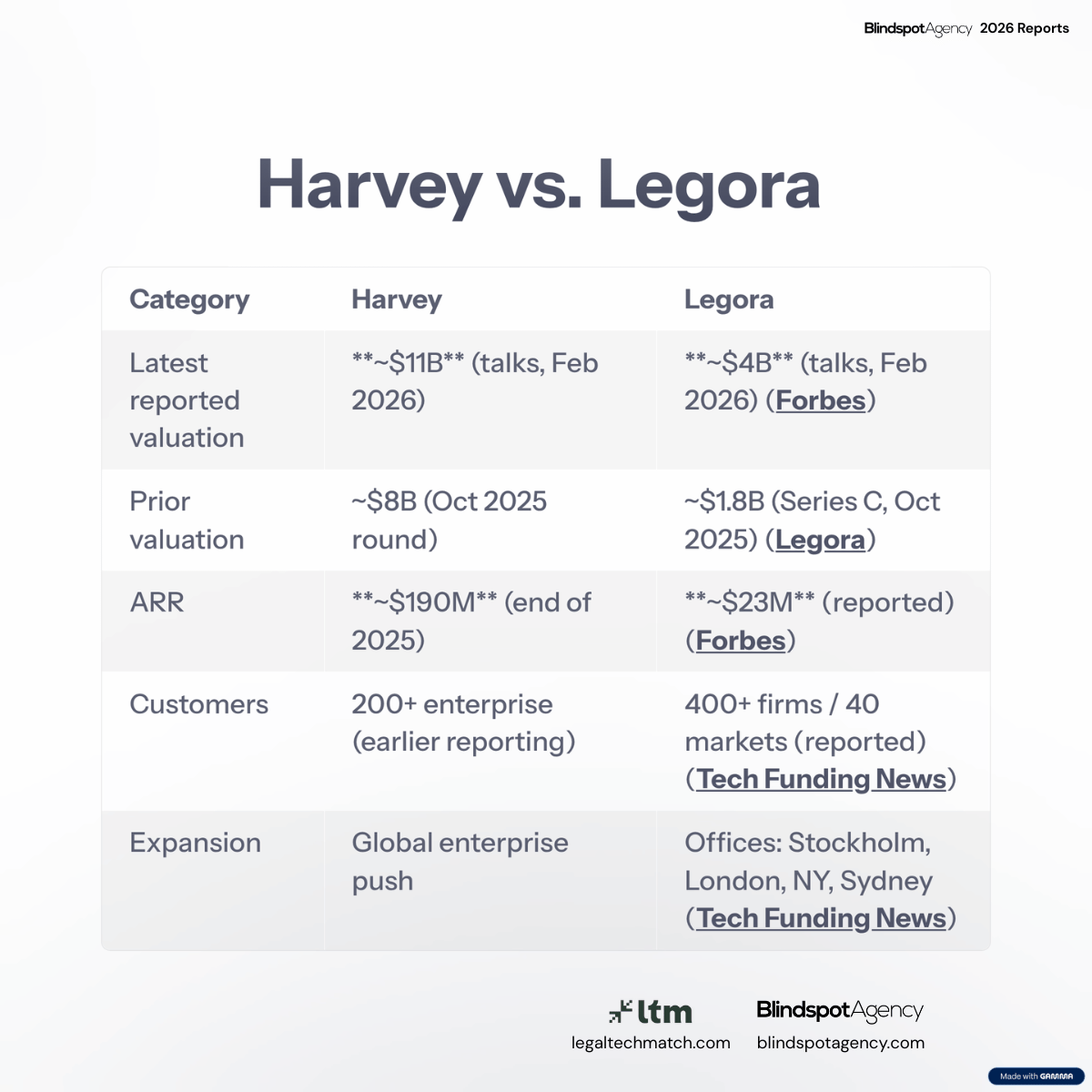
But beneath the symmetry, these companies are compounding in different ways:
- Harvey’s compounding advantage: brand demand + enterprise gravity + category default status
- Legora’s compounding advantage: collaborative workflows + international adoption velocity + rapid firm expansion
That difference matters more than any single funding round.
4. What the rest of legaltech can still do in 2026
2025 was a record year for legaltech valuations, traffic, and revenue. Harvey and Legora were major beneficiaries, and they’re now poised to deploy massive war chests for even faster growth in 2026. But even as they pull ahead, the window hasn’t closed for everyone else.
Here’s what these two behemoths have demonstrated—and what smaller legaltech companies can apply immediately:
– Take organic search and LLM discovery seriously
Follow their lead and invest in technical SEO and content, plus GEO/AEO (visibility in generative search and answer engines). Pair that with off-site PR and authority-building—signals that both traditional search engines and answer engines reward.
Most legaltech firms are orders of magnitude behind leaders in rankings, backlinks, and brand demand, and also have low visibility in answer engines (the new “shortlist layer”). With the capital leaders have raised, competitors need to move faster to catch up.
– Positioning over everything
Harvey and Legora are now in an arms race to out-feature each other—and they have the resources to do it. Online, you can already find users saying the products feel similar, and some even prefer going back to foundational models for certain tasks.
That creates an opening: win by owning a specific workflow, role, or use case so deeply that you become the default—especially in areas where horizontal platforms will be slow to focus.
With ~10,000 legaltech companies globally, the category is still young, fragmented, and full of opportunity. The next wave of market share won’t be won by “better prompts” alone—but by teams that understand how demand, distribution, and AI-native discovery now intersect.
As Harvey Specter put it: “People like you think I get lucky. Here’s the thing: I make my own luck.”
2026 will belong to the teams that make their own luck.
Need a marketing partner to compete with Harvey and Legora?
If you’re a smaller legal AI or legal SaaS company, we help you compete with category leaders by improving how you’re discovered across:
-
Google Search (SEO)
-
AI Overviews + answer engines (GEO/AEO)
-
Comparison pages and shortlist queries
-
Positioning + conversion-ready landing pages that turn traffic into pipeline
Contact us for the full report to see how the top legaltech startups stack up—and what it will take to compete in SEO, GEO/AEO, and pipeline growth this year.
This article is part of an ongoing series to bring AI clarity to Law firms with our partner Legal Tech Match. Check out their article here for another take on the HarveyAI takeover
Share this article

Written by : Emmanuel Tamrat
Emmanuel Tamrat is the founder of Blindspot Agency, specializing in SEO, content strategy, and CRO for local businesses and Shopify brands globally.
Follow us
Latest articles
April 1, 2026

April 1, 2026